Emergency Lighting Logbook: What to Record, and Why Fittings Fail the Annual Test
An emergency lighting logbook is the record that proves your emergency lights were tested, what the tests found, and what was done about it. When a fire officer, an insurer or an auditor asks whether the emergency lighting works, the logbook is the answer. When it's missing, incomplete, or shows the same failed fitting for six months, that's a finding on its own, whatever the lights are doing.
This post is about the record: what goes in it, and what the annual test usually reveals.
The tests, side by side
Most places follow the same pattern: a short functional test often, and a full-duration test once a year. The exact rules depend on where you are.
| UK (BS 5266-1 guidance) | US (NFPA 101, Life Safety Code) | |
|---|---|---|
| Frequent test | Monthly: a short functional test of every fitting on battery | Monthly: at least 30 seconds on battery |
| Annual test | The full rated duration, commonly 3 hours | 90 minutes on battery |
| Who | A competent person | As your authority having jurisdiction requires |
Check the rules that apply to your building. Local codes and your fire risk assessment may ask for more.
What the logbook should record
For every test
- Date and type of test (monthly or annual)
- Who did it
- Which fittings were tested, by ID or location, not just "all"
- Result for each fitting: passed, failed, or not accessible
- For the annual test: how long each fitting lasted, especially any that went out before the end
For every fault
- What was wrong: lamp out, battery failed early, charging light off, physical damage, sign not visible
- When it was found
- What was done to make the area safe in the meantime, if the fault left an escape route dark
- When it was fixed, and by whom
- The retest showing the fix worked
For the system
- An up-to-date list or plan of every fitting, with its location, and whether it's maintained or non-maintained
- Any changes: fittings added, moved or removed, and why
- Battery replacement dates
A logbook that records "monthly test: OK" for three years without a single fitting ID doesn't prove much.
Why fittings fail the annual test
The monthly test catches a dead lamp. The annual test catches the slower problems.
Tired batteries. A fitting can light for a 30-second monthly test and still go out after 40 minutes of a 3-hour test. Batteries age, especially in hot ceiling voids. Many sites plan battery replacement on a cycle rather than waiting for failures.
Self-test units nobody reads. Self-testing fittings run their own tests and show a status light. They only help if someone looks at the lights and records what they show. A red status LED that's been red since spring is still a failure.
Fittings added in a refit and never tested. A refurbishment adds new emergency fittings, or moves old ones, and nobody updates the fitting list. The new ones are never tested, and the logbook still lists the old layout.
Charging that was switched off. A fitting on a circuit that's switched off at night or over a holiday doesn't charge. It may pass the monthly test and fail the long one.
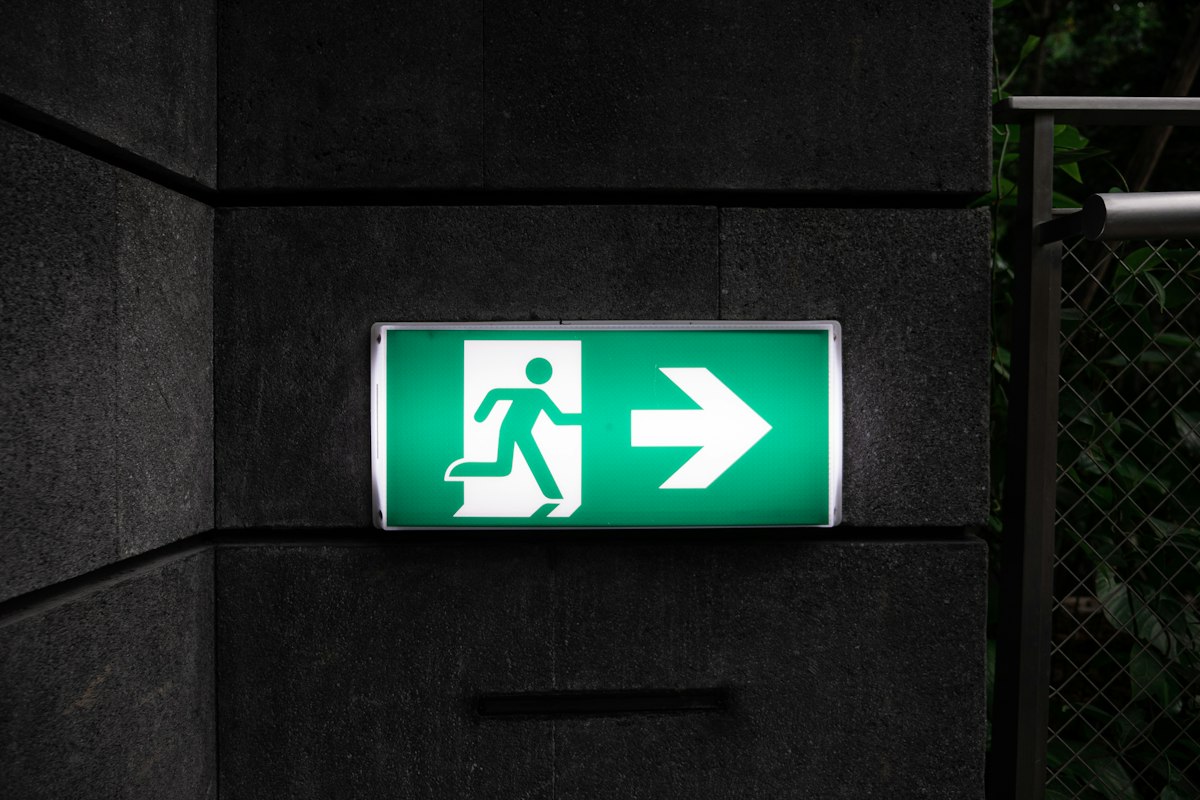
Exit signs nobody can see. The sign is lit, but a new partition, shelving or a hanging banner blocks the view from the escape route. A sign has to be visible to be any use, and the test record should say whether it is.
Physical damage. Diffusers cracked, fittings knocked off by forklifts or ladders, signs painted over.
After a failure
- Record it against the fitting ID.
- Make the route safe if a dark area affects escape: temporary lighting, restricting use of that route, or extra staff on duty, depending on your fire risk assessment.
- Repair with an owner and a date.
- Retest and record the retest.
The gap between steps 1 and 4 is what an inspector looks at first.
Doing it on the walk
Testing emergency lighting means walking every corridor, stairwell, plant room and car park, often at night or out of hours, looking up at fittings. Writing up a fitting-by-fitting record afterwards from notes on a clipboard is where the IDs go missing.
Speak while you walk, and the document writes itself. Say what you see at each fitting — "EL-14, first-floor stair, out at 40 minutes, photo. EL-15 fine. Exit sign by the canteen, lit but blocked by the new menu board." — and the logbook entry is written, with the fitting, the result and the photo, as you go.
Key Takeaway
The free emergency lighting inspection covers the monthly and annual tests, one entry per fitting, with faults and actions, and fills in on a phone. In the ReportWalk app last month's failures carry into this month's test. First walks free.
Related
- Emergency lighting inspection: the free template, fitting by fitting
- How to do a fire risk assessment: where emergency lighting fits into the bigger picture
- Fire alarm inspection: the other system that has to work when the power doesn't
- Back-to-school facility inspection: the summer walkthrough, including emergency lighting
Frequently asked questions
What should an emergency lighting logbook contain? The date and type of each test, who did it, every fitting tested with its result, any faults with what was done about them and when they were fixed, retest results, a current list or plan of all fittings, and battery replacement dates.
How often should emergency lighting be tested? Commonly a short functional test every month and a full-duration test once a year. In the UK the annual test usually runs for the fittings' rated duration, often 3 hours. In the US, NFPA 101 calls for a monthly 30-second test and an annual 90-minute test.
Why do emergency lights fail the annual test but pass the monthly one? Usually because the battery has aged. It holds enough charge for a short test but can't last the full duration. Charging problems and fittings on switched circuits cause the same pattern.
Do self-testing emergency lights still need a logbook? Yes. Someone still needs to check and record the status each fitting reports, and to deal with any faults.
How long should emergency lighting records be kept? Keep them for as long as your fire risk assessment, insurer or local authority expects. Many sites keep several years of records so trends in failures can be seen.
What happens if the logbook isn't kept? In an inspection or after an incident, there's no evidence the system was tested and maintained, which can count against the responsible person even if the lights work.