Attic Inspection: What Every Inspector Should Check & Document
The attic is where home inspections go wrong. Not because inspectors don't know what to look for — but because they rush through it, skip it when access is difficult, or miss the subtle signs that something's failing above the ceiling.
I've seen inspectors spend 45 minutes in a kitchen documenting cosmetic issues and 5 minutes in an attic that's actively growing mold. That's backwards. The attic tells you more about a home's health than almost any other space: how the roof is aging, whether the home breathes properly, if moisture is destroying the structure from the inside out, and whether the insulation is actually doing its job.
This guide covers every component of a thorough attic inspection — the things you must check, the things most inspectors miss, and how to document it all efficiently.
Before You Enter: Access and Safety
Finding and Evaluating Access Points
Attic access comes in several forms:
- Pull-down stairs — most common in residential. Check the springs, hinges, and landing condition.
- Scuttle holes — smaller openings, usually in a closet ceiling. You'll need a ladder.
- Walk-up stairs — older homes sometimes have finished or semi-finished attic spaces with proper stairs.
- No access — if the attic has no access point, document it. Don't create one.
Document the access location and condition in your report. If access is limited or you can't safely enter, state that clearly and explain what wasn't inspected and why.
Safety First
- Test the structure before committing your weight. Step only on joists or trusses, never between them — you'll go through the ceiling.
- Watch for:
- Exposed nails protruding from roof sheathing (the ones you don't see until they're in your scalp)
- Low clearance and truss webs at head height
- Loose-fill insulation hiding wiring, junction boxes, or open holes
- Vermiculite insulation (may contain asbestos — do not disturb)
- Evidence of pests (wasps, bats, raccoons, squirrels)
- Bring your respirator. Attics accumulate dust, fiberglass particles, and potentially mold spores.
- Headlamp > handheld flashlight. You need both hands free.
Key Takeaway
If you encounter vermiculite insulation (small, accordion-like granules, often gray-brown or gold), do not walk through it or disturb it. Vermiculite from the Libby, Montana mine (sold as Zonolite) is contaminated with asbestos. Note it in your report and recommend professional testing before any disturbance.
Insulation: Type, Depth, and Coverage
Insulation is the first thing most homeowners ask about, and it's the first thing you should evaluate in the attic.
What to Check
-
Type of insulation:
- Fiberglass batts — pink, yellow, or white rolls laid between joists
- Blown-in fiberglass — loose, fluffy, often white or yellow
- Blown-in cellulose — gray, dense, newspaper-like texture
- Spray foam (open-cell or closed-cell) — applied to underside of roof deck
- Vermiculite — flag for potential asbestos
- Rigid foam boards — less common in attics
-
Depth and R-value:
- Measure the depth in multiple locations (center of attic, eaves, over living spaces)
- Use the DOE insulation guidelines for recommended R-values by climate zone
- Pennsylvania falls in Climate Zones 4–6, requiring R-49 to R-60 for attic insulation (that's roughly 14–17 inches of fiberglass or 12–15 inches of cellulose)
- Most existing homes have far less than recommended — document the actual depth and note the deficiency
-
Coverage and gaps:
- Insulation pulled back from recessed lights or mechanical equipment
- Missing insulation over additions, garages, or bump-outs
- Compressed batts (compressed fiberglass loses R-value dramatically)
- Gaps around plumbing penetrations, electrical boxes, chimneys
- Eaves/soffits — is insulation blocking ventilation? (This is a common problem)
-
Vapor barriers:
- In cold climates, the vapor barrier (kraft facing on batts, or poly sheeting) should face down — toward the conditioned space
- Double vapor barriers (new insulation laid over old faced insulation) trap moisture — flag this
Note
The single most common insulation deficiency I find in attic inspections: insulation stuffed into the eave area, blocking soffit vents. This kills ventilation, traps moisture, and accelerates roof decay. Every time. Check the eaves.
How to Document Insulation Findings
Your report should include:
- Insulation type
- Measured depth (in inches)
- Approximate R-value based on type and depth
- Coverage assessment (complete, gaps noted, areas missing)
- Any concerns (blocking vents, moisture damage, vermiculite, compressed batts)
- Photo of insulation with a measuring tape for reference
Ventilation: The System Most Inspectors Underestimate
Poor attic ventilation is the root cause of more attic problems than any other single factor. Moisture buildup, ice dams, premature shingle aging, mold growth — they all trace back to ventilation failures.
How Attic Ventilation Works
A properly ventilated attic uses balanced intake and exhaust to move air through the space:
- Intake (low) — typically soffit vents along the eaves
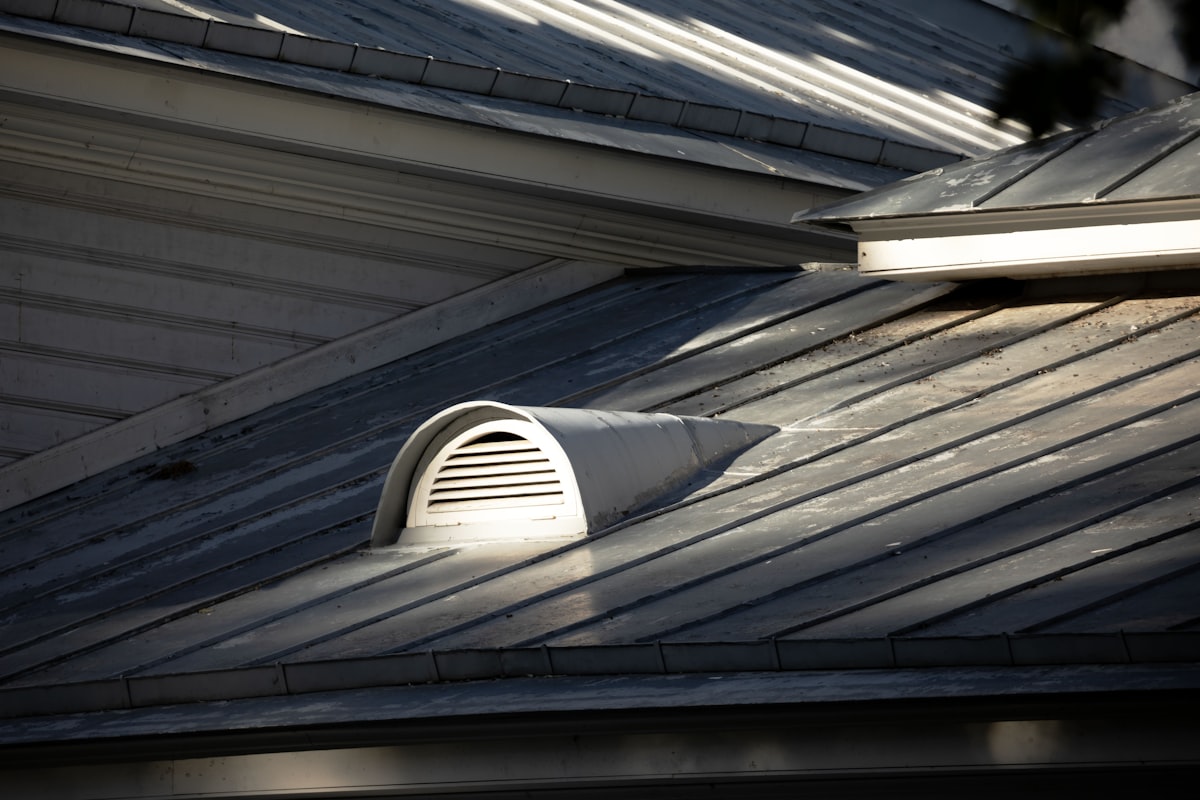
- Exhaust (high) — ridge vents, gable vents, roof vents, or powered fans
Air enters through the soffits, rises as it warms, and exits through the higher exhaust vents. This continuous flow removes heat in summer and moisture in winter.
What to Check
-
Soffit vents:
- Are they present? How many?
- Are they blocked by insulation? (Use a flashlight to look toward the eaves)
- Are baffles installed to keep insulation away from vents?
- Paint over mesh (blocked by homeowner painting)?
-
Ridge vents:
- Is there a continuous ridge vent? Or are there gaps?
- Can you see daylight through the ridge? (You should see some light if functional)
- Is the ridge vent filter/baffle intact?
-
Gable vents:
- Condition of screens (damaged screens = pest entry)
- Size relative to attic square footage
- Note: gable vents + ridge vents can short-circuit airflow (air flows gable-to-ridge, bypassing the lower attic)
-
Roof vents / turbines / powered fans:
- Are they functional?
- Powered fans — are they thermostat controlled? Humidity controlled?
- Check for backdrafting through bathroom fan ducts
-
Balanced ventilation calculation:
- General rule: 1 square foot of net free ventilation area per 150 square feet of attic floor space (or 1:300 if a vapor barrier is present and ventilation is balanced between intake and exhaust)
- Most attics are under-ventilated. Count the vents and estimate.
Signs of Ventilation Failure
- Condensation on roof sheathing — water droplets or staining on the underside of the plywood/OSB
- Rusty nail tips — nails poking through the sheathing show rust from condensation
- Mold on sheathing — dark staining, especially at the north-facing roof deck
- Ice dams (in winter) — thick ice at the eaves, icicles, water staining on fascia
- Excessive heat — attic should not be dramatically hotter than outdoor temperature in summer (suggests no ventilation)
Note
Rusty nail tips on the underside of roof sheathing are one of the earliest and most reliable indicators of ventilation problems. If the nails are rusting, moisture is condensing on cold metal — and it's condensing on the sheathing too, even if you can't see staining yet.
Structural: Framing, Sheathing, and the Roof from Below
The attic gives you the only view of the roof structure from the inside. Use it.
Framing Members
-
Rafters or trusses:
- Look for cracks, splits, or notches cut into framing (often done improperly for ductwork or plumbing)
- Check for sagging or bowing — sight along the rafter line
- Engineered trusses should never be cut or modified. If you see modifications, flag it immediately.
- Look for sister rafters (repairs) — they indicate past structural issues
-
Collar ties and rafter ties:
- Are they present? Every other rafter pair at minimum should have collar ties
- Are connections secure? (Nails pulling out, split wood)
-
Ridge board/beam:
- Is it continuous? Cracked? Sagging?
- Look at the peak from one end of the attic — any visible dip indicates a structural concern
Roof Sheathing
- Material: Plywood, OSB, or skip sheathing (boards with gaps — common on older homes with wood shingles)
- Condition:
- Delamination (layers of plywood separating — sign of moisture damage)
- Dark staining (water intrusion, condensation)
- Soft spots (press gently — sheathing should feel solid)
- Daylight visible through gaps or holes
- Fasteners: Are nails properly driven? Over-driven nails reduce shear strength. Missed nails (shiners) indicate installation quality.
Chimney and Fireplace
If a chimney passes through the attic:
- Check clearance from combustible framing (minimum 2 inches for masonry, varies for metal flues)
- Look for missing fire stops
- Check for mortar deterioration, cracking, or leaning
- Verify the chimney flashing from the attic side (you can often see daylight if flashing has failed)
Moisture: The Silent Destroyer
Moisture in the attic is the inspector's biggest catch. It doesn't announce itself until the damage is severe.
Sources of Attic Moisture
-
Bathroom exhaust fans venting into the attic — this is the number one source of attic moisture problems, and it's incredibly common. The fan should vent through the roof or soffit to the exterior. If the duct terminates in the attic, that's a major deficiency.
-
Kitchen exhaust venting into attic — same problem, with grease added.
-
Dryer vents — occasionally routed through the attic. Should never terminate inside the attic.
-
Plumbing vent leaks — where plumbing vent stacks penetrate the roof, look for water staining around the pipe.
-
Roof leaks — check around valleys, penetrations (vents, chimneys, skylights), and along the roof-wall junction.
-
Condensation from poor ventilation — especially in winter when warm, moist air from the living space meets cold roof sheathing.
What Moisture Damage Looks Like
- Water staining — dark rings or streaks on framing and sheathing
- Active dripping — document location relative to roof penetrations
- Mold growth — black, green, or white fuzzy growth on sheathing or framing
- Wood rot — soft, spongy wood that yields to a probe or screwdriver
- Efflorescence — white crystalline deposits on masonry (chimney, foundation elements)
- Rust — on metal straps, connectors, HVAC components, or nail tips
Key Takeaway
Always check directly below plumbing vent penetrations, around chimney flashings, and at valleys. These three areas account for the vast majority of attic water intrusion. If you only have 5 minutes in the attic, check these first.
Mechanical Systems in the Attic
Many homes have HVAC equipment, ductwork, or electrical components in the attic. Don't ignore them.
HVAC
- Air handler or furnace in attic — check for a drain pan, and whether the secondary drain is functional
- Ductwork — look for disconnected joints, damaged insulation, collapsed flex duct, and condensation on cold ducts
- Refrigerant lines — check insulation condition on the suction line
Electrical
- Junction boxes — must be covered (open junction boxes are a deficiency)
- Wiring type — note if you see knob-and-tube, aluminum branch circuit, or other older wiring
- Buried wiring — wiring buried under insulation isn't a defect, but note any exposed splices or damaged insulation
- Recessed lights — older non-IC-rated recessed lights should have insulation clearance. Missing clearance is a fire risk.
Plumbing
- Vent stacks — check condition where they penetrate the roof
- Water supply or drain lines in attic — in cold climates, these are vulnerable to freezing. Note their presence and insulation status.
The Inspection Report: Documenting Your Attic Findings
A thorough attic inspection generates a lot of data. Your report needs to capture it all clearly without becoming a disorganized wall of text.
Structure Your Attic Section
- Access — type, location, condition
- Insulation — type, depth, R-value, coverage, concerns
- Ventilation — intake type, exhaust type, adequacy, issues
- Structure — framing type, condition, modifications
- Sheathing — material, condition, moisture evidence
- Moisture — sources identified, damage observed
- Mechanical — HVAC, electrical, plumbing findings
- Recommendations — prioritized list of repairs or further evaluation
Photo Documentation
Every attic section needs photos:
- Overall view of attic space
- Insulation with measuring tape
- Any deficiencies (moisture stains, mold, damaged framing, disconnected ducts)
- Bathroom fan termination point
- Ventilation components
The challenge with attic documentation is practical: you're in a cramped, dark space, often on your hands and knees, trying to take photos and write notes while not stepping through the ceiling. This is exactly where voice-based reporting tools earn their keep. Instead of typing notes on your phone while balancing on a joist, you describe what you're seeing and ReportWalk captures it. Your hands stay free for your flashlight and camera.
Common Attic Deficiencies: A Quick-Reference Checklist
Here's a summary of the most frequently found attic issues, ranked by how often I encounter them:
- Bathroom fan venting into attic (extremely common)
- Insufficient insulation depth (almost universal in older homes)
- Insulation blocking soffit vents (very common)
- Missing or inadequate vapor barriers
- Condensation/moisture staining on sheathing (especially north-facing)
- Open junction boxes
- Disconnected or damaged ductwork
- Evidence of pest activity (droppings, nesting, chewed wiring)
- Modified trusses (cut for storage or access)
- Missing baffles at eaves
Related Inspection Guides
For deeper dives into components you'll encounter during attic inspections:
- Roofing Inspection Checklist — the exterior side of what you're seeing from below
- Electrical Inspection Checklist — wiring standards and common deficiencies
- HVAC Inspection Checklist — everything about the systems you'll find in the attic
The Bottom Line
The attic isn't glamorous. It's hot, cramped, dark, and occasionally full of surprises you'd rather not find. But it's one of the most information-dense spaces in any home, and a thorough attic inspection separates competent inspectors from everyone else.
Take your time up there. Check the insulation depth — actually measure it. Look at the ventilation — count the vents. Examine the sheathing — touch it, probe it. Follow the bathroom fan ducts — see where they actually terminate. These aren't exotic skills. They're the fundamentals that catch real problems before they become expensive emergencies.
And document everything as you go. The attic is the worst place to rely on memory — by the time you're back at your desk, you've forgotten which rafter had the crack and which vent was blocked. Voice-first tools like ReportWalk let you narrate your findings in real-time, hands-free, so nothing gets missed and your report writes itself while you work.
The attic always tells the truth. Your job is to listen.