What an Insurance Property Risk Survey Is, and Why It's a Walk
An insurance risk survey is a visit to a commercial property on behalf of an insurer, made before cover starts or while it's in force, so the insurer understands what it's insuring. A risk surveyor (sometimes called a risk engineer) walks the site, looks at how the building is built, what goes on inside it, how it's protected and what's around it, and writes a report. The underwriter uses that report to decide whether to offer cover, on what terms and at what premium. The report usually ends in risk improvements: things the insured must or should fix, often with a deadline. In the UK it's usually called a risk survey; in the US the same visit is more often a loss control survey or loss control inspection.
That's the paragraph. The rest of this page covers who does it, what it isn't, the framework most surveys follow, and then the walk itself, section by section, ending with the report.
Who does the survey
The surveyor is usually one of three people:
- The insurer's own risk surveyor or risk engineer. Most larger commercial insurers employ them, or commission them.
- A broker's risk team. Some brokers survey their clients' sites before taking the risk to market, so the presentation to insurers is stronger.
- An independent surveyor instructed by the insurer or the broker.
A survey can happen at new business (before cover is offered), at renewal, after a significant change to the site or the business, or as a follow-up to check that earlier risk improvements were done.
What a risk survey isn't
Several other visits look similar and get confused with it.
- A valuation, or rebuild cost assessment. This works out what it would cost to rebuild the property from scratch (the reinstatement value), so the sum insured is right. It's related and often done on the same visit, but it answers a different question: how much, not how likely.
- A loss adjuster's visit. A loss adjuster comes after a claim, to establish what happened, whether it's covered and what it's worth. A risk surveyor comes before anything has gone wrong.
- A building condition survey. That's about the fabric: roofs, walls, services, and what repairs will cost. A risk survey notices condition only where it affects the chance or size of a loss.
- A fire risk assessment. In the UK, the occupier (the "responsible person") has a legal duty to carry out a fire risk assessment, under the Regulatory Reform (Fire Safety) Order 2005 in England and Wales and equivalent law elsewhere in the UK. The insurer's survey is not that assessment and doesn't replace it. A good surveyor will ask to see the fire risk assessment and whether its actions were closed.
Put simply: the fire risk assessment protects people and is owed to the law; the risk survey protects the insurer's money and is owed to the underwriter.
COPE: the framework most surveys follow
Property underwriting is widely organised around four letters: COPE.
- Construction. What the building is made of, how it's put together, and how well it would resist and contain a fire.
- Occupancy. What goes on inside: the processes, the materials, the hazards.
- Protection. What would detect, fight or limit a loss: sprinklers, alarms, fire doors, security, management.
- Exposure. What's outside the boundary that could cause a loss: neighbours, flood, weather.
Not every report uses those headings, and many add sections for electrics, business interruption and management. But COPE is how you plan the walk.
1. Before the visit
The survey starts at a desk.
- The schedule. What's insured, the sums insured for buildings, contents, stock and business interruption, and any existing conditions or warranties.
- The previous survey, if there is one, and above all its outstanding risk improvements. A requirement set two years ago and never closed is the first thing to check on site.
- Claims history. What has gone wrong here before, and whether the cause was fixed.
- The site on a map. Neighbours, fire service access, and flood maps (the Environment Agency's in England, FEMA's in the US).
2. The meeting
Most surveys begin with half an hour in an office with whoever runs the site.
- Who's who. Site manager, maintenance lead, whoever holds the fire and security responsibilities.
- What the business does, in plain words, and what's changed since the last survey.
- Processes, from goods in to goods out.
- Hours and headcount. Shifts, weekends, and when the site is empty. Nobody notices a fire in a building that's empty from Friday night to Monday.
- Paperwork to see on the walk: the fire risk assessment, sprinkler and alarm maintenance records, electrical test reports, hot work permits.
3. Construction
- Walls, roof and frame. Masonry, steel frame, timber, concrete. Anything combustible in the structure matters.
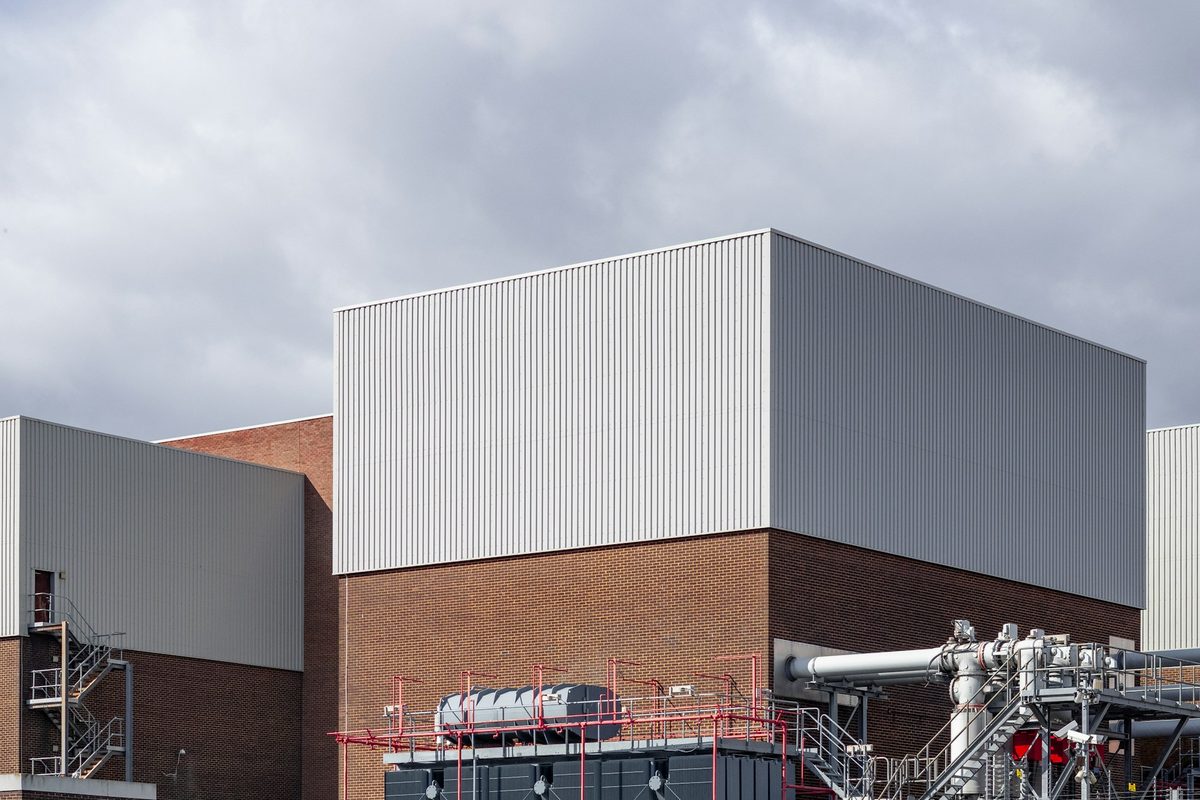
- Composite panels. Insulated sandwich panels are common in warehouses, food factories and cold stores, and the core is what the surveyor wants to know. An expanded polystyrene (EPS) core burns and can spread fire hidden inside the panel; a mineral wool core doesn't burn. Other cores, such as PIR, sit in between and vary by product. Where there's a certification label or documentation showing the panel was tested to a recognised fire standard, photograph it. Where there's none, the surveyor may look at a cut edge or a damaged panel to see the core.
- Age and alterations. Extensions, mezzanines, infilled bays, anything added without the rest of the building being considered.
- Compartmentation. Fire walls between areas, whether they go right up to the roof, and whether openings in them are protected. A fire wall with a hole cut through it for a cable tray isn't a fire wall.
4. Occupancy
- Process hazards. Heat, flammable liquids, dust, ovens, dryers, fryers, spray booths, anything that runs hot or makes sparks.
- Hot work. Welding, cutting, grinding and roofing torches cause a large share of serious fires. Is it done on site, and how is it controlled?
- Storage. What's stored, how it's packaged (plastic packaging is a fire load in its own right), and how high. Storage stacked higher than the sprinkler system was designed for can overwhelm it.
- Housekeeping. Clear aisles, no combustibles against the walls, dust and lint cleaned from ducts and machines.
- Waste. Where the skips and bins are. Many insurers want external waste kept a set distance from the building, often around 10 metres, and bins lidded and locked, because a fire started in a skip against the wall is a common way to lose a building.
- Lithium-ion battery charging. Forklift and pallet truck charging bays, e-bikes, power tools, scooters. Surveyors look for charging in a designated area, away from stock and combustibles, with detection over it and not left unattended overnight where that can be avoided. Insurer requirements here are still developing.
5. Protection
Fire
- Sprinklers. Is the whole building covered, including extensions and mezzanines? When was the system last serviced, and is the valve set tested routinely? A weekly test is the usual routine under UK rules. In the US, NFPA 25 sets the inspection and testing schedule. Photograph the valve set, the pressure gauges and the test log.
- Fire alarm. Coverage, the last service, and whether it's monitored by a remote receiving centre. An unmonitored alarm in an empty building rings for nobody.
- Extinguishers. Present, the right type for the hazard, serviced, and not being used as doorstops.
- Fire doors. Closing and latching, not propped open, and not damaged.
- Hot work permits. Is there a permit system, are completed permits kept, and does it include a fire watch after the work?
Security
- Intruder alarm. Its grading (in the UK and Europe, alarms are graded 1 to 4 under EN 50131, and insurers often specify a grade), whether it's monitored and whether it gets a police response.
- CCTV. Coverage, recording, and whether anyone watches it.
- Locks, doors and shutters. The quality of the physical security, especially on the doors that matter.
- The perimeter. Fences, gates and lighting, and how easy it is to reach the building unseen.
6. Exposure
- Neighbours. What's next door, and how close. A timber yard or a tyre store across a narrow alley is a risk to this building whatever this building does.
- Flood. Proximity to rivers and the sea, surface-water risk, and any history of flooding. Is stock stored on the floor in a low-lying unit?
- Natural hazards as relevant to the region. Windstorm and hurricane, wildfire, earthquake, subsidence, freeze. In a hurricane or wildfire zone, these can be the most important part of the survey. Elsewhere they may be a single line.
7. Utilities and electrical
- Electrical installation testing. Periodic inspection and testing of the fixed installation, and whether any faults found were fixed. In the UK that's usually an EICR.
- Thermographic survey. A thermal imaging survey of distribution boards and switchgear, which finds hot connections before they become fires. It's often a requirement, commonly on a yearly cycle.
- Housekeeping around electrics. Nothing stored against distribution boards, no daisy-chained extension leads, no damaged cables.
- Other utilities. Gas, compressed air, boilers and pressure vessels, and their inspection records.
8. Business interruption
A fire doesn't only destroy a building. It stops a business, and the loss of income can be bigger than the property damage.
- Single points of failure. One production line, one oven, one server room, one site.
- Key machinery. What would take longest to replace? Is it bespoke, imported, or out of production?
- Suppliers and customers. A single supplier of a critical part, or a single customer that takes most of the output.
- Recovery plans. Is there a business continuity plan, and is it current?
9. The report
The survey isn't finished when the walk is. It's finished when the underwriter has a document they can act on. It usually contains:
- Description of the site, under the COPE headings, clear enough for someone who's never been there.
- Risk grading. Most insurers grade the risk against their own scale, and some reports include an estimate of the largest likely loss. Grading scales and loss estimates vary between insurers.
- Risk improvements, each with a priority and a deadline. Most reports separate requirements (must be done, sometimes a condition of cover) from recommendations (should be done). Terms vary between insurers, so the report should say what each one means.
- Progress on previous risk improvements: done, in progress, or not started.
- Photographs, each tied to the finding it supports.
What most risk surveys get wrong
Photos not tied to findings. A gallery of forty photos at the back of the report, and a risk improvement on page six that says "combustible storage adjacent to building". Which photo? Where? A photo belongs next to the finding it proves.
Vague risk improvements. "Improve housekeeping" can't be done, checked or closed. "Remove pallet stack from the north wall of the warehouse and keep it at least 10 metres from the building" can.
No follow-up of the last survey. A requirement from the previous visit that nobody checked is a requirement that doesn't exist. The first page of a good survey says what happened to the last one's improvements.
Generic boilerplate. Paragraphs copied from the last report, describing a building that's since been extended or re-let. The underwriter is paying for what's there today.
Doing it on site
A risk survey is a long walk through a big building, with a torch, a camera, and a site manager talking the whole way. The notes end up as fragments, the photos as numbered files, and the report gets written days later at a desk, where "the panels on the extension looked like EPS" loses its photo.
Speak while you walk, and the document the law or the client wants writes itself. Say what you see where you see it, and take the photo while you're standing there. For example: "North extension, added about 2015 according to the site manager. Composite panel walls, damaged panel by door 4 shows a white bead core, looks like EPS, photo of the cut edge, no certification label visible. Sprinkler valve set in the pump house, pressures reading normal, last weekly test entry in the log is three weeks ago, photo of the log and the gauges. Battery charging bay at the end of aisle 12: six forklift chargers, shrink-wrapped stock racked within two metres, no detection over the bay, photo. That's a requirement." Every finding has a place, a time and a photo, and the risk improvement is drafted before you've reached the car park.
Key Takeaway
There's no dedicated insurance risk survey template yet. For now, the closest are the commercial property inspection, which covers the building and its services, and the fire hazard risk assessment, which covers the fire side of occupancy and protection. Both are free and fill in on a phone. ReportWalk is the iPhone app for doing it by voice, and your first three walks are free.
Related
- Commercial property inspection: the building, its structure and its services
- Fire hazard risk assessment: ignition sources, fire loads and the protection against them
- Warehouse inspection checklist: racking, storage, housekeeping and charging areas
- Property condition assessment: the condition survey that sits next to a risk survey
- Commercial property inspection checklist: exterior, interior, MEP and fire safety, walked in order
Frequently asked questions
What is an insurance risk survey? A visit to a commercial property on an insurer's behalf, before or during cover, to understand the risk. The surveyor looks at the building's construction, what goes on inside it, how it's protected and what's around it, and writes a report the underwriter uses to set terms and premium. It usually includes risk improvements with deadlines.
What does COPE stand for in insurance? Construction, Occupancy, Protection and Exposure. It's the framework widely used in property underwriting to describe a risk: what the building is made of, what happens in it, what would limit a loss, and what outside the site could cause one.
What's the difference between a risk survey and a loss control survey? Mostly the name. "Risk survey" and "risk improvement" are the usual UK terms; "loss control survey" or "loss control inspection" is more common in the US. The job is the same: look at the site on the insurer's behalf, and say what would reduce the chance or size of a loss.
Is an insurance risk survey the same as a fire risk assessment? No. In the UK, a fire risk assessment is the occupier's legal duty and is about keeping people safe. An insurer's risk survey is for the insurer, about the risk of loss to the property and the business. A surveyor will often ask to see the fire risk assessment, but the survey doesn't replace it.
What happens if I don't complete the risk improvements? It depends on the policy and the insurer. A recommendation is advice. A requirement may be a condition of cover, and not completing it by the deadline could affect the terms at renewal, or a claim connected to it. Check the wording of your policy and the survey report, and talk to your broker if a deadline can't be met.
Is a rebuild valuation part of the risk survey? Sometimes. A reinstatement or rebuild cost assessment is often done on the same visit, but it's a different question: what the property would cost to rebuild, so the sum insured is right, rather than how likely a loss is.