Exterior Inspection Checklist: Siding, Grading & Everything Outside
The exterior inspection is where your home inspection starts — both literally and figuratively. Before you ever step inside, you're reading the outside of the house like a book. The siding tells you about moisture management. The grading tells you where water goes when it rains. The gutters and downspouts tell you whether anyone's been maintaining this property or just letting it go.
A thorough exterior inspection checklist covers far more than most people realize. You're not just glancing at the siding and moving on — you're evaluating wall cladding, trim, flashing, grading, drainage, gutters, downspouts, walkways, driveways, retaining walls, exterior electrical, hose bibs, and every other component that faces the weather. This guide breaks down what to check, what to document, and what the common deficiencies look like for each system.
Why the Exterior Matters So Much
The building exterior is the first line of defense against water, the single most destructive force a house faces. Every exterior component serves one primary purpose: keep water out and direct it away from the structure.
When the exterior fails, everything behind it suffers. Moisture gets behind siding, rots sheathing, grows mold, damages insulation, and compromises structural framing. Improper grading directs water toward the foundation instead of away from it, leading to basement leaks, foundation settlement, and chronic moisture problems.
Note
Water damage is the most common insurance claim for homeowners, and the vast majority of residential water damage originates at the building exterior — through failed cladding, poor grading, damaged gutters, or inadequate flashing. A thorough exterior inspection catches these issues before they become five-figure repair bills.
Your exterior inspection section is also the first major section in most report templates, which means it sets the tone for how your client perceives the entire report. Nail this section with clear observations, good photos, and actionable findings.
Siding and Wall Cladding
Wall cladding is the most visible exterior component and varies widely depending on the home's age, region, and construction style. Each material has its own failure modes and inspection focus areas.
Vinyl Siding
Vinyl is the most common residential siding material in the U.S. It's affordable, low-maintenance, and performs well when properly installed.
What to check:
- Buckling or warping — usually caused by improper nailing (nails driven too tight, preventing thermal expansion) or heat exposure from nearby grills or reflected sunlight
- Cracks or holes — impact damage, hail damage, or UV degradation
- Loose panels — listen for rattling in wind; check that panels are locked into the panel below
- Ground contact — vinyl should terminate above grade, not buried in soil. Soil contact holds moisture against the sheathing and invites insects.
- J-channel condition — check around windows and doors. Caulked J-channels trap moisture; open-bottom J-channels drain properly.
- Melted areas — increasingly common from reflected sunlight off energy-efficient windows. The concave reflection concentrates heat enough to melt vinyl. Document the location and the reflecting window.
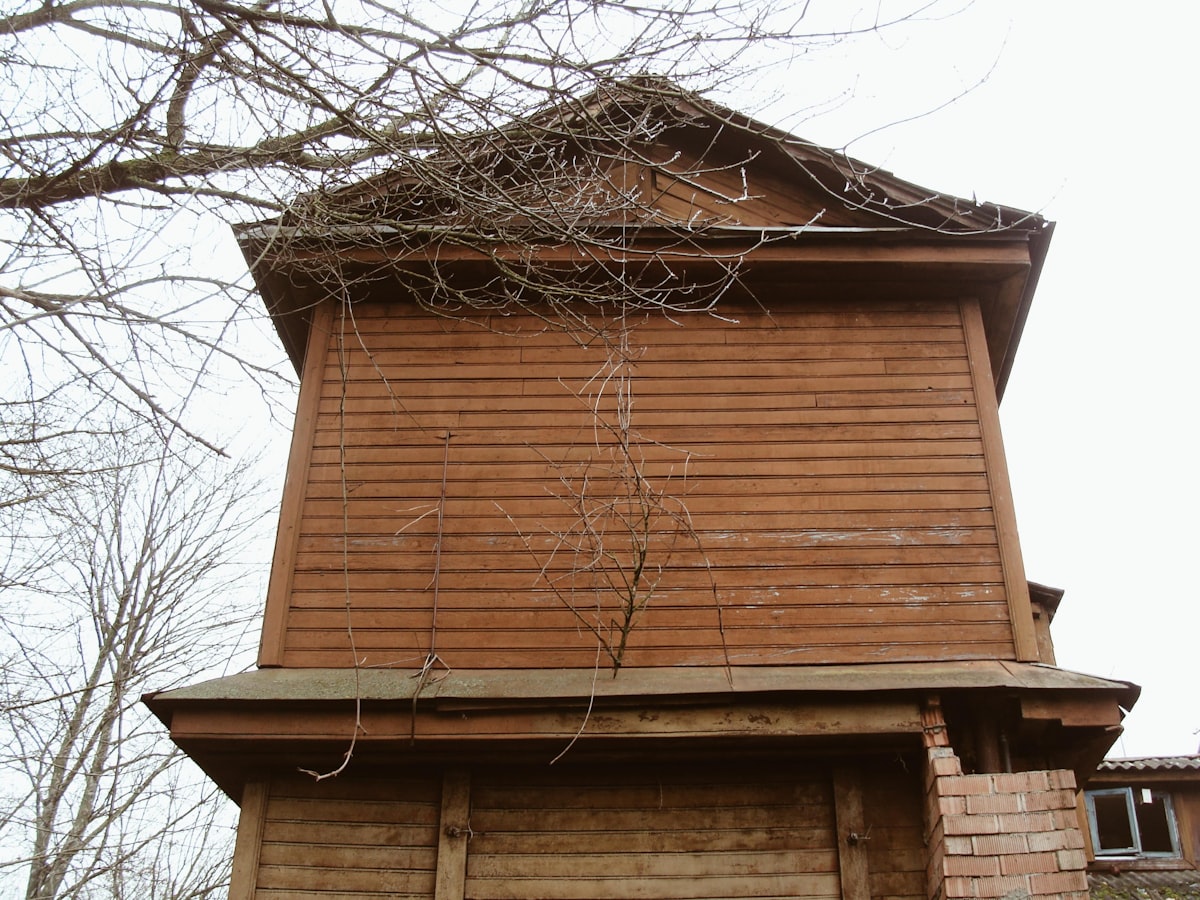
Wood Siding (Clapboard, Shingle, Board-and-Batten)
Wood siding is beautiful when maintained and a maintenance nightmare when neglected.
What to check:
- Paint or stain condition — peeling, flaking, fading, bare wood exposure
- Rot — probe with an awl at vulnerable areas: bottom courses, around windows, behind downspouts, at trim joints. Soft spots indicate decay.
- Splitting or cupping — boards that are warped, cupped, or split allow moisture behind the cladding
- Gaps at joints — open joints between boards need caulking or flashing to prevent water intrusion
- Ground clearance — wood siding should be at least 6-8 inches above grade. Less than that invites moisture damage and termites. For more on wood-destroying organisms, see our termite inspection guide.
- Fungal growth — moss, mildew, or algae indicate chronic moisture exposure
Fiber Cement Siding (HardiePlank and Similar)
Fiber cement has become hugely popular for its durability, fire resistance, and appearance that mimics wood.
What to check:
- Cracks — fiber cement is rigid and can crack from impact or improper installation (nailing too close to edges, not pre-drilling)
- Paint condition — factory-primed fiber cement needs painting. Check for peeling, especially at cut edges where the factory primer was removed.
- Caulk joints — fiber cement requires properly caulked joints at butt joints and transitions. Failed caulk = moisture entry.
- Ground clearance — minimum 6 inches above grade per manufacturer specs, 2 inches above hard surfaces (patios, stoops)
- Kickout flashing — where roof-to-wall transitions meet, kickout flashing directs water into the gutter rather than behind the siding. Missing kickout flashing is one of the top causes of concealed water damage behind fiber cement.
Stucco (Traditional and EIFS)
Stucco inspection requires extra attention because problems are often concealed behind the surface.
What to check:
- Cracks — hairline cracks are cosmetic. Cracks wider than 1/16" or in stair-step patterns may indicate structural movement.
- Staining — dark staining below windows, at transitions, or near the foundation suggests moisture behind the stucco
- Bulging — indicates the stucco has separated from the substrate (delamination). Tap with your knuckles — a hollow sound confirms separation.
- Ground contact — stucco should terminate at a weep screed above grade, allowing moisture behind the stucco to drain out
- Weep screed — check the bottom edge. Is there a visible weep screed? Is it buried in soil or mulch? Buried weep screeds trap moisture in the wall.
- EIFS vs. traditional — Exterior Insulation and Finish Systems look like stucco but are a completely different assembly. EIFS is a moisture-sensitive system that requires proper flashing and sealant details. If you suspect EIFS, note it and recommend evaluation by a specialist if there are signs of moisture intrusion.
Brick and Stone Veneer
Brick and stone are durable but not maintenance-free.
What to check:
- Mortar joint condition — deteriorated, cracked, or missing mortar joints allow water penetration. Repointing is the typical repair.
- Step cracking — stair-step cracks through mortar joints often indicate foundation settlement. Document the crack pattern, width, and location. Our foundation inspection guide covers settlement indicators in detail.
- Efflorescence — white crystalline deposits on the brick surface. Indicates moisture moving through the masonry and depositing mineral salts. It's cosmetic but signals moisture presence.
- Weep holes — brick veneer walls need weep holes at the bottom course (every 24-33 inches) to allow moisture behind the veneer to drain. Missing or clogged weep holes trap moisture in the wall assembly.
- Flashing — above windows, doors, and at the roofline, flashing should direct water out through weep holes. Often concealed but you can sometimes see the flashing edge.
- Spalling — brick faces that are flaking, crumbling, or popping off. Caused by freeze-thaw cycles in moisture-saturated brick. Common in older homes in cold climates.
Key Takeaway
When documenting siding deficiencies, photograph each issue from two distances: a close-up showing the defect detail and a wider shot showing the location on the house. This helps the reader (and any contractor) find the exact spot. Your report structure matters — check our guide on writing inspection reports for more on effective documentation.
Grading and Drainage
If you remember only one thing from this entire exterior inspection checklist, remember this: water flows downhill. Your job is to determine whether the grading directs water away from the foundation or toward it.
What to Check
- Slope away from foundation — the ground should slope away from the foundation at a minimum of 6 inches of fall over the first 10 feet (roughly a 5% grade). Walk the entire perimeter and note areas where the grade is flat or slopes toward the house.
- Soil contact with siding — soil, mulch, or landscaping material piled against siding holds moisture against the wall and provides a pathway for termites and other insects. The siding should be visible above grade.
- Mulch depth — excessive mulch (more than 2-4 inches) retains moisture against the foundation. Mulch volcanoes around trees and piled against the house are common problems.
- Window wells — basement windows below grade should have properly installed window wells with gravel drainage at the bottom. Wells shouldn't be full of leaves, debris, or standing water.
- Swales and drainage channels — some properties use landscape swales to direct water. Verify they're intact and actually moving water away from the structure.
- Neighbor property drainage — if the adjacent property slopes toward the house you're inspecting, note the potential for water intrusion. This is an observation, not necessarily a defect you can solve, but your client should know about it.
Common Grading Deficiencies
- Negative grading — soil slopes toward the foundation. This is the #1 exterior deficiency documented in home inspections nationwide. It causes basement leaks, crawl space moisture, and accelerated foundation deterioration.
- Settled backfill — the soil along the foundation was backfilled during construction and has since settled, creating a trough that collects water right where you don't want it
- Planting beds against foundation — flower beds and gardens against the house often create a bowl that holds water against the foundation
- Hardscape directing water to foundation — patios, walkways, or driveways that slope toward the house
Gutters and Downspouts
Gutters are simple in concept and chronically neglected in practice. A functional gutter and downspout system collects roof water and deposits it away from the foundation. A dysfunctional one dumps concentrated water right next to the house — worse than having no gutters at all.
Gutters — What to Check
- Present where needed — are gutters installed on all eave edges? Missing sections concentrate water at foundation areas.
- Material and condition — aluminum (most common), vinyl, copper, galvanized steel. Check for rust, holes, separating seams, and sagging sections.
- Slope — gutters should slope toward downspouts (roughly ¼" per 10 feet). Standing water in gutters indicates incorrect slope or sagging.
- Debris — visible debris, plant growth, or granule buildup in gutters indicates deferred maintenance
- Attachment — gutters pulling away from fascia. Spikes or hangers failing. Sections hanging or tilted.
- Ice damage — in cold climates, gutters pulled away or bent by ice dam formation. Our roofing inspection checklist covers ice dam conditions in more detail.
Downspouts — What to Check
- Connected to gutters — loose or disconnected downspouts dump water at the foundation
- Extensions — downspouts should discharge at least 4-6 feet from the foundation. Short downspouts that dump water right at the foundation wall are one of the most common exterior deficiencies.
- Underground connections — some downspouts connect to underground drain pipes. These can clog or collapse. If the connection appears intact, note it as an underground drain. If you see water pooling at a downspout that supposedly drains underground, the underground pipe is likely compromised.
- Splash blocks — if present, verify they're positioned to direct water away from the foundation, not sitting flat or aimed back toward the house
Trim, Fascia, and Soffit
These components protect the roof edges and provide ventilation — and they're where a lot of rot hides.
Fascia
- Rot — the bottom edge of fascia boards is particularly vulnerable, especially behind gutters where trapped moisture accelerates decay
- Paint condition — peeling or bare wood exposed to weather
- Gutter attachment damage — holes, splitting from gutter spikes
Soffit
- Ventilation — soffit vents allow attic airflow. Verify vents are present and not blocked by paint, insulation, or debris. Inadequate soffit ventilation contributes to ice dams and attic moisture problems. See our attic inspection guide for more on ventilation.
- Damage or holes — damaged soffit panels are entry points for animals (squirrels, raccoons, birds, bats)
- Staining — water stains on soffit suggest ice dam backup or roof leak above
- Material condition — wood soffit is prone to rot; aluminum and vinyl are more durable but can be dented or dislodged
Trim (Window, Door, Corner, and Band)
- Caulk condition — failed caulk around windows and doors is a primary water entry point
- Rot at joints — where trim pieces meet, water collects and rot starts. Bottom edges of window trim are particularly vulnerable.
- Paint condition — bare wood exposure
- Separation from wall — gaps between trim and siding indicate movement or failed fasteners
Exterior Electrical
What to Check
- Weatherproof covers (in-use covers) — exterior receptacles must have covers that protect the outlet while a cord is plugged in. Old-style "bubble" covers that only protect when nothing is plugged in don't meet current code.
- GFCI protection — all exterior receptacles should be GFCI-protected. Test each one. Our electrical inspection checklist covers GFCI testing in detail.
- Service entrance condition — check the weatherhead, service mast, drip loops, and meter base for damage, corrosion, or clearance issues
- Exposed or damaged wiring — any exterior wiring should be in appropriate conduit or rated for exterior exposure
- Light fixtures — operational, properly mounted, appropriate for exterior use
- Outlet box condition — exterior boxes should be weatherproof rated. Missing covers, broken boxes, or standard interior boxes used outdoors are deficiencies.
Hose Bibs and Exterior Plumbing
What to Check
- Functional test — turn on each hose bib. Check for leaks at the handle, packing nut, and at the wall penetration.
- Anti-siphon (vacuum breaker) — most codes require anti-siphon devices on hose bibs to prevent backflow contamination of the potable water supply. Many newer homes have frost-proof sillcocks with built-in vacuum breakers. Older homes may have none.
- Frost-proof sillcocks — in cold climates, verify hose bibs are the frost-proof type (long stem that shuts off water inside the heated envelope of the house). Non-frost-proof hose bibs in freezing climates are prone to burst pipes.
- Leaks at wall penetration — water seeping in at the sillcock penetration can cause concealed wall damage
Walkways, Driveways, and Stoops
These are functional and safety components, not just cosmetic.
Walkways
- Trip hazards — heaved, settled, or cracked sections creating uneven surfaces. Settlement greater than ½" between adjacent sections is generally considered a trip hazard.
- Slope toward house — walkways adjacent to the foundation should slope away, not toward it
- Condition — major cracks, deterioration, spalling concrete
Driveways
- Cracks — note the pattern. Isolated shrinkage cracks are cosmetic. Cracks at the garage foundation junction may indicate settlement. Widespread alligator cracking on asphalt indicates failure of the base layer.
- Settlement — sunken sections near the garage can direct water into the garage or under the foundation
- Drainage — does the driveway drain water toward the garage or house? Is there a functioning drain at the garage entrance?
Stoops, Porches, and Steps
- Attachment to house — look for separation between the stoop/porch and the house foundation. Gaps indicate the stoop is settling independently.
- Railings — required where the walking surface is 30+ inches above grade (varies by jurisdiction, some require at 24"). Verify railings are present, secure, and at proper height (34-38 inches typically). Baluster spacing should not allow a 4-inch sphere to pass through.
- Step condition — uniform riser height and tread depth. Uneven risers are a trip hazard. Concrete steps with crumbling edges or spalling surfaces need documentation.
- Slope — stoops and porches should slope slightly away from the house for drainage (¼" per foot typical)
Retaining Walls
Retaining walls manage grade changes and soil pressure. When they fail, the results are dramatic and expensive.
What to Check
- Leaning or bulging — indicates the wall is being pushed by soil pressure beyond its design capacity
- Cracks — horizontal cracks in concrete or block retaining walls suggest lateral soil pressure exceeding the wall's strength
- Drainage — weep holes should be present at the base to relieve hydrostatic pressure behind the wall. Clogged or missing weep holes accelerate failure.
- Material condition — deteriorating timber, crumbling block, rusting steel
- Proximity to structures — a failing retaining wall near the house foundation is a serious concern
Other Exterior Components
Don't forget:
- AC condenser unit — check pad level, clearances, refrigerant line insulation, electrical disconnect presence. Our HVAC inspection checklist covers this in detail.
- Fuel storage — propane tanks, oil fill pipes. Check for rust, leaks, proper distance from structures.
- Exterior faucets and irrigation — test function, check for leaks
- Address visibility — note if house numbers are clearly visible from the street (a common observation item)
- Vegetation against the house — trees and shrubs touching the house trap moisture, provide insect pathways, and can cause physical damage. Recommend maintaining 12+ inches of clearance.
Key Takeaway
Photograph all four sides of the house during your exterior inspection. These overview photos provide context for specific deficiency photos and help the reader understand the home's orientation and overall condition. A systematic photo approach keeps your report professional and complete.
Putting Your Exterior Inspection Together
A systematic approach prevents missed items. Work your way around the house in one direction (clockwise or counterclockwise — pick one and stick with it), documenting as you go:
- Start at the front — siding, trim, windows, entry, walkway
- Move to the right side — siding, grading, utilities, clearances
- Continue to the rear — siding, deck/porch, grading, drainage
- Finish with the left side — complete the loop
At each wall, look at:
- Wall cladding (bottom to top)
- Trim and flashing
- Windows and doors (exterior side)
- Grading at the base
- Gutters and downspouts above
- Any penetrations or attachments
This methodical approach ensures nothing gets missed, even on complex properties with multiple roof lines, additions, and varied cladding.
For inspectors looking to streamline field documentation, ReportWalk lets you dictate your exterior findings into your iPhone as you walk the perimeter. Describe what you see at each wall section and the app structures your observations into clean report sections — no need to remember everything until you get back to your desk.
Final Thoughts
The exterior inspection sets the stage for everything that follows inside. Water management, structural integrity, safety, and maintenance condition are all visible from the outside if you know where to look. A thorough exterior inspection checklist isn't just about finding problems — it's about reading the house and understanding how it manages the elements.
Take your time outside. The clues the exterior gives you will inform what you look for in the basement, attic, and everywhere in between. Document clearly, photograph generously, and give your client a complete picture of what's happening on the outside of their investment.